
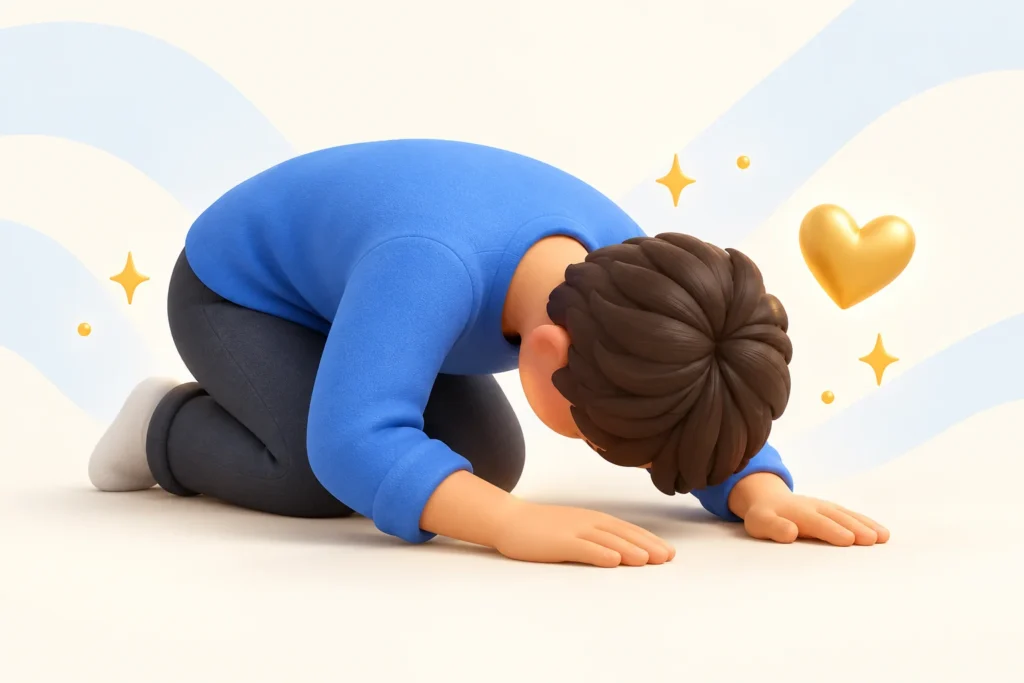
The bow down emoji 🙇 shows a person bowing deeply. In text messages, it can express an apology, gratitude, respect, or a request for help. It can also communicate playful admiration—similar to saying, “I bow to you” after someone does something impressive.
Its emoji name is Person Bowing. Although people call it the bow down emoji, bowing head emoji, or sorry bow emoji, these informal names generally refer to the same character.
The easiest way to understand it is to read the accompanying message. “I’m sorry 🙇” expresses regret, “Thank you 🙇” expresses appreciation, and “You’re incredible 🙇” expresses admiration.
🙇 Bow Down Emoji Copy & Paste
Explore 37 bowing, kneeling, and related emojis. Tap any emoji to copy it instantly.
What Does the Bow Down Emoji Mean?
The person bowing emoji depicts a gesture rather than a single emotion. That allows it to fit several situations, from a sincere apology to an exaggerated compliment between friends.
Here are the main ways it can work in a message:
| Meaning | What the sender may be communicating | Example |
|---|---|---|
| Apology | “I’m sorry” or “That was my mistake” | “I forgot to attach the document. Sorry 🙇” |
| Gratitude | “I really appreciate your help” | “Thanks for staying late to help me 🙇” |
| Respect | “I recognize your effort or ability” | “That took serious patience 🙇” |
| Request | “Could you please help me?” | “One small favor before you leave? 🙇” |
| Playful admiration | “You’ve impressed me” | “You made all of that from scratch? 🙇” |
These are contextual interpretations, not separate official definitions. The same emoji can feel serious in one conversation and funny in another.
An Apology or Admission of a Mistake
The bowing emoji can reinforce a direct apology. It suggests that you recognize the mistake and want the other person to know you are sorry.
For example:
“I mixed up the meeting times. That was my mistake 🙇”
This works better than sending the emoji by itself because the message identifies what went wrong.
For a minor mix-up between friends, a short apology may be enough:
“I thought you meant next Friday. Sorry 🙇”
For a more serious problem, add what you will do to fix it:
“I sent the outdated price list. I’m sorry for the confusion. I’ve attached the corrected version and will double-check the next update 🙇”
The useful part is the acknowledgment and corrective action. The emoji adds tone, but it cannot take responsibility on your behalf.
Gratitude and Appreciation
A bow can also communicate thanks, especially when someone has put in extra effort.
“You checked every reference for me. Thank you 🙇”
Compared with a casual “thanks,” this may feel more appreciative or a little more expressive.
It can fit situations such as:
- A friend helping you move.
- A colleague covering an unexpected task.
- Someone sharing detailed advice.
- A family member making time to support you.
- A reader pointing out an error kindly.
For instance:
“Thanks for catching that broken link. I’ve fixed it now 🙇”
The wording makes the gratitude clear. Without it, the recipient might wonder whether you are thanking them or apologizing.
Respect for Someone’s Skill or Effort
The bow down emoji can express recognition when someone does something difficult well.
“You explained that in a way I finally understood 🙇”
Here, the bow does not necessarily imply that the sender feels inferior. It can simply recognize another person’s knowledge, patience, or hard work.
You might use it after watching a great performance, receiving thoughtful advice, or seeing a friend complete a demanding project.
A specific compliment makes the message stronger:
“The detail in that drawing is incredible 🙇”
That tells the person what impressed you, rather than leaving them to interpret a standalone emoji.
Asking for a Favor
The person bowing emoji can soften a request or emphasize “please.”
“Could you check the last slide before I present it? 🙇”
Among friends, it can add a slightly pleading or humorous tone:
“Please tell me you saved a slice of cake 🙇”
However, politeness still comes from the request itself. Adding 🙇 does not make an unreasonable demand considerate.
Compare:
“Do this tonight 🙇”
with:
“Would you have time to review this tonight? No problem if tomorrow works better 🙇”
The second gives the recipient a clear request and room to respond honestly.
Playful “I Bow to You” Admiration
Sometimes 🙇 is an exaggerated reaction to an impressive achievement or an everyday talent.
“You remembered everyone’s coffee order without writing it down? 🙇”
This is similar to saying “I bow to you,” “You win,” or “That deserves respect.”
The tone can be deliberately dramatic:
“You folded a fitted sheet properly. Teach me your ways 🙇”
It works particularly well when both people understand the humor. In an unfamiliar or formal conversation, a direct compliment may be easier to interpret.
Why Is the Bowing Emoji Associated With Japan?
The deep bow depicted by 🙇 is associated with dogeza, a Japanese gesture involving kneeling and bowing deeply toward the ground. The gesture can be connected with a profound apology or an earnest request.
That cultural background helps explain why the emoji is associated with apologizing and asking for forgiveness.
However, a casual emoji message does not necessarily carry the full significance of the physical gesture. Someone texting “Thanks for the notes 🙇” may simply be expressing appreciation.
It is useful to distinguish the depicted gesture from the meaning intended in a particular conversation. Neither “every bow means submission” nor “every bow means sorry” accurately describes all uses of this emoji.
If a sender’s intention is unclear, the surrounding words and your relationship provide better clues than the image alone.
What Does 🙇 Mean in Text Messages?
In a text conversation, the message before or after the emoji usually provides the most reliable explanation.
Consider these examples:
| Message | Likely intended tone |
|---|---|
| “Sorry I disappeared yesterday 🙇” | Apologetic |
| “You helped me more than you realize 🙇” | Grateful |
| “Please send me the recipe 🙇” | Requesting |
| “That presentation was excellent 🙇” | Admiring |
| “Fine, you were right about the ending 🙇” | Playfully conceding |
These examples show possible readings rather than guaranteed meanings. A sentence that is sincere between two people might be sarcastic between others.
What If Someone Sends Only 🙇?
A standalone bowing emoji can be harder to interpret.
If you just helped the sender, it may mean “thank you.” If they have acknowledged a mistake, it may reinforce an apology. If you shared an achievement, it may express admiration.
Look at what happened immediately before the emoji:
- You corrected an error: They may be acknowledging the mistake.
- You completed a favor: They may be thanking you.
- You shared impressive work: They may be complimenting you.
- They asked for help: They may be emphasizing the request.
When the meaning matters, a brief question is better than a confident guess.
Bowing Emoji Meaning From a Girl or Guy
The bow down emoji does not have a separate meaning based on whether a girl or guy sends it.
A woman sending 🙇 might be apologizing, expressing thanks, or joking. A man sending it can mean the same things.
The message, relationship, and situation matter more than gender.
For example:
“Thanks for walking me through that 🙇”
This communicates appreciation regardless of who sends it.
Likewise:
“Please forgive my terrible movie recommendation 🙇”
This sounds like a playful apology without implying romance.
Avoid treating the emoji as proof of attraction, submission, or a particular emotional attachment. Those conclusions need more context.
Is the Bow Down Emoji Romantic or Flirty?
The bow down emoji is not inherently romantic. It can appear in a flirtatious exchange, but it can just as easily appear in a conversation with a friend, coworker, or classmate.
Compare:
“Thanks for sharing the class notes 🙇”
with:
“You looked incredible tonight. I have no words 🙇❤️”
The second message has a more affectionate tone because of its wording and the heart. The bow alone does not create that meaning.
If someone repeatedly uses 🙇 with compliments, it may be part of their expressive texting style. It still should not be treated as a reliable signal of romantic interest on its own.
How to Reply to the Bow Down Emoji
Respond to what the person said or did, rather than choosing a reply based only on the symbol.
When Someone Is Apologizing
If the issue is minor and resolved, a simple acknowledgment can work:
“Thanks for letting me know. We’re good.”
If it needs attention, address the issue clearly:
“I appreciate the apology. Please send the corrected file when you can.”
You do not have to dismiss a meaningful problem just because someone uses an apologetic emoji.
When Someone Is Thanking You
A warm, brief response is usually enough:
“Happy to help!”
“You’re welcome. Glad it worked.”
“Anytime—thanks for the kind message.”
When Someone Is Complimenting You
Accept the compliment naturally:
“Thank you! I spent a lot of time on it.”
For a playful conversation:
“Thank you, thank you. I’ll be here all week 😄”
When Someone Is Asking for Help
Answer the request directly:
“Sure—send me the draft.”
Or set a clear boundary:
“I can’t review it tonight, but I have time tomorrow morning.”
The emoji may make the request feel warmer, but it does not require you to agree.
Bow Down Emoji vs. Folded Hands vs. Kneeling
These emojis can overlap in conversations about respect, requests, or gratitude, but they depict different actions.
| Emoji | Name | What it depicts | How it may fit a message |
|---|---|---|---|
| 🙇 | Person Bowing | A person bowing deeply | Apology, gratitude, respect, or a request |
| 🙏 | Folded Hands | Two hands pressed together | Thanks, a request, prayer, or hope |
| 🧎 | Person Kneeling | A person resting on their knees | Kneeling or a context-specific action |
| 🫡 | Saluting Face | A person giving a salute | Respect, acknowledgment, or a playful “on it” |
🙇 vs. 🙏
Use 🙇 when you want the bowing gesture to be part of the expression. Use 🙏 when folded hands better match your intended message.
Both can accompany “thank you” or “please,” but they are not identical.
“I’m sorry for the mix-up 🙇”
“Hope everything goes well tomorrow 🙏”
Folded Hands is sometimes called the praying hands emoji, although prayer is only one possible use.
🙇 vs. 🧎
Bowing and kneeling are related physical positions, but the emoji are distinct.
The bowing character bends forward deeply. The kneeling character depicts the kneeling posture without necessarily showing a deep bow.
Choose based on the action you want to describe rather than assuming 🧎 automatically means apology.
🙇 vs. 🫡
The bowing emoji may fit thanks, regret, or admiration. The salute may fit acknowledgment.
“Thanks for taking the time to help 🙇”
“Understood. I’ll handle it 🫡”
Neither gesture has one universal tone. The words still do most of the work.
Does 🙇 Mean a Headache, Massage, or Push-Up?
The emoji’s intended name is Person Bowing. It does not officially depict a headache, massage, or push-up.
However, small illustrations can be visually ambiguous. Depending on the artwork, someone may notice the lowered head and nearby hands before recognizing a bow.
If you want to communicate something else, choose a more direct symbol or explain it in words.
For example:
- Feeling unwell: “I have a headache and need to rest.”
- Getting a massage: 💆 may fit the intended activity.
- Exercising: Describe the workout instead of relying on 🙇 to represent a push-up.
Using words avoids turning an unclear picture into an unclear message.
Bow Down Emoji Combinations to Try
Short combinations can add emphasis, but their meanings are creative rather than standardized.
| Combination | Suggested expression | Example |
|---|---|---|
| 🙇❤️ | Warm appreciation | “Thanks for always being there 🙇❤️” |
| 🙇✨ | Admiration | “That final performance was beautiful 🙇✨” |
| 🙇👑 | Playful praise | “Nobody organizes a trip like you 🙇👑” |
| 🙇🙏 | An earnest request or apology | “Please forgive the late reply 🙇🙏” |
| 🙇📚 | Appreciation for study help | “Those revision notes helped so much 🙇📚” |
| 🙇🎂 | Appreciation for baking | “You made my favorite cake 🙇🎂” |
| 🙇💐 | Thanks or appreciation | “Thank you for making the day special 🙇💐” |
Use combinations sparingly. A clear sentence with one or two relevant emojis is usually easier to understand than a long string.
Using the Bowing Emoji at Work
Whether 🙇 fits a workplace message depends on the team’s usual communication style and the seriousness of the situation.
In an informal chat, it can make a thank-you feel more personal:
“Thanks for answering all my questions today 🙇”
For an important apology, prioritize the facts:
“I missed the deadline. I’m sorry. I can send the completed draft by 11 a.m. tomorrow.”
The message is clear without needing an emoji.
In customer support, a direct apology and solution generally provide more value than an expressive symbol:
“I’m sorry the wrong item arrived. We’ve arranged a replacement and will send the tracking details once it ships.”
If emojis are part of your brand’s established style, they can support the tone. They should not replace useful information about what happens next.
How to Find and Type the Bow Down Emoji
You can copy 🙇 from this page or use your device’s emoji keyboard.
- Open the app where you want to write.
- Tap or click the text field.
- Open the emoji keyboard or picker.
- Search for “bow,” “bowing,” or “person bowing.”
- Choose your preferred version.
- Add enough text to make the meaning clear.
Searching for “bow” may also return unrelated symbols, such as a ribbon or bow and arrow. “Person bowing” is a more specific search term.
Keyboard results vary by language, device, and software version. If search does not find it, copying the complete character is an easy alternative.
Why Does the Bowing Emoji Look Different Across Devices?
Emoji are text characters rendered using artwork supplied by a platform, app, or font. Different systems may show different clothing, hairstyles, facial details, or viewing angles.
That means the bow on your screen may look slightly different to the person receiving it.
Some variants also use joined sequences. If the receiving system does not support the complete sequence, it may display separate components or missing-character boxes.
If a bowing emoji does not display correctly:
- Check for app and operating system updates.
- Copy the complete emoji again.
- Try viewing it in another app.
- Use the simpler 🙇 version if a variant is unsupported.
- Include words so the message remains understandable.
If everyone needs to see exactly the same illustration, an image or sticker is more suitable than a text emoji.
Frequently Asked Questions
What Is the Bow Down Emoji Called?
Its emoji name is Person Bowing. People also search for it as the bow down emoji, bowing head emoji, or person bowing deeply emoji.
Does the Bowing Emoji Always Mean Sorry?
No. It can accompany an apology, but it can also express thanks, respect, admiration, or a request. The surrounding message establishes the intended meaning.
What Does 🙇♀️ Mean?
🙇♀️ is Woman Bowing. It depicts the same general bowing gesture as 🙇 and can serve the same conversational purposes.
What Does 🙇♂️ Mean?
🙇♂️ is Man Bowing. It may accompany an apology, appreciation, respect, or a request. It does not establish a different emotional meaning from the other bowing variants.
Can the Bow Down Emoji Be Sarcastic?
Yes, it can be used sarcastically when the wording and relationship support that reading. For example, an exaggerated “Of course, your majesty 🙇” may be teasing. However, the emoji itself does not prove sarcasm.
Does 🙇 Mean Someone Is Submissive?
Not necessarily. It depicts a bow, but a casual message may simply express appreciation or admiration. You should not infer someone’s personality, intentions, or relationship role from this emoji alone.
Is It Appropriate to Send 🙇 After a Serious Apology?
It can accompany an apology if it suits the relationship, but the apology should clearly acknowledge the problem and explain any necessary action. For a serious or sensitive issue, direct wording may communicate your sincerity more effectively.
Is the Bow Down Emoji the Same as “I’m Not Worthy”?
It can support that playful expression when someone impresses you. However, “I’m not worthy” is one possible conversational interpretation, rather than the emoji’s official meaning.