

A friendly emoji adds warmth, welcome, or support to a message. 😊 often suits a casual thank-you, 👋 works as a greeting, and 🤗 can suggest a virtual hug. The best choice depends on what you’re saying and who you’re talking to.
“Friendly emoji” describes a group of possible choices. A cheerful face, a wave, and a yellow heart can all feel friendly, but they bring different levels of enthusiasm or affection. You might greet a new neighbor with 👋 and save 💛 for someone you know well.
Start with the message you want to send. The emoji can help the tone come through.
Friendly Emojis to Copy and Paste
Click any of these 12 emojis from the first column to copy and paste into your message, caption, or profile. The descriptions are common uses, so leave room for the sender’s habits and the conversation.
| Emoji | Name | Common Friendly Use |
|---|---|---|
| Smiling Face with Smiling Eyes | Warm thanks or an appreciative reply | |
| Slightly Smiling Face | A quiet smile or polite acknowledgment | |
| Grinning Face | Cheerful enthusiasm | |
| Grinning Face with Smiling Eyes | An openly happy response | |
| Waving Hand | Saying hello or goodbye | |
| Victory Hand | Peace or a casual sign-off | |
| Smiling Face with Open Hands | Welcome, support, or a virtual hug | |
| Yellow Heart | Warm affection, including between friends | |
| White Heart | Affection, sympathy, or support | |
| Handshake | Agreement or cooperation | |
| Thumbs Up | Approval or acknowledgment | |
| Sparkles | Celebration or cheerful emphasis |
These names follow the Unicode emoji list. “Hugging face” is also a familiar name for 🤗.
On a phone: Touch and hold beside the emoji, adjust the selection handles around the character, and choose Copy. Open your message, touch and hold in the typing area, and choose Paste.
On a computer: Highlight the emoji, press Ctrl+C on Windows or Command+C on a Mac, then paste it with Ctrl+V or Command+V.
Copy the character rather than a screenshot of it. Leave a space between the last word and the emoji so the message stays easy to read.
Choose an Emoji That Fits the Situation
A friendly emoji works best when it supports something specific: a greeting, appreciation, encouragement, or an agreement. Choosing by purpose makes more sense than searching for one face that suits every conversation.
The names and conversations below are fictional examples of everyday use.
Greetings and Everyday Replies
For an introduction, 👋 gives the message a clear greeting. Maya could write, “Hi, I’m Maya from upstairs 👋” in a building group chat. The words introduce her; the wave adds a casual welcome. It also works for “See you next week 👋” when a conversation ends. ✌️, the Victory Hand or peace sign, can also suit a casual sign-off: “Catch you tomorrow ✌️.”
In a new group, give people a little context, too. “Hi everyone 👋 I’m helping with Saturday’s event. Where should I drop off the supplies?” starts a conversation others can answer. A wave on its own may suit a quick hello between friends, while an introduction helps new contacts understand why you’re getting in touch.
😊 can make a thank-you feel appreciative without turning it into a big announcement. Consider this exchange:
Maya: “Thanks for the ride today 😊”
Sam: “Anytime! Glad I could help.”
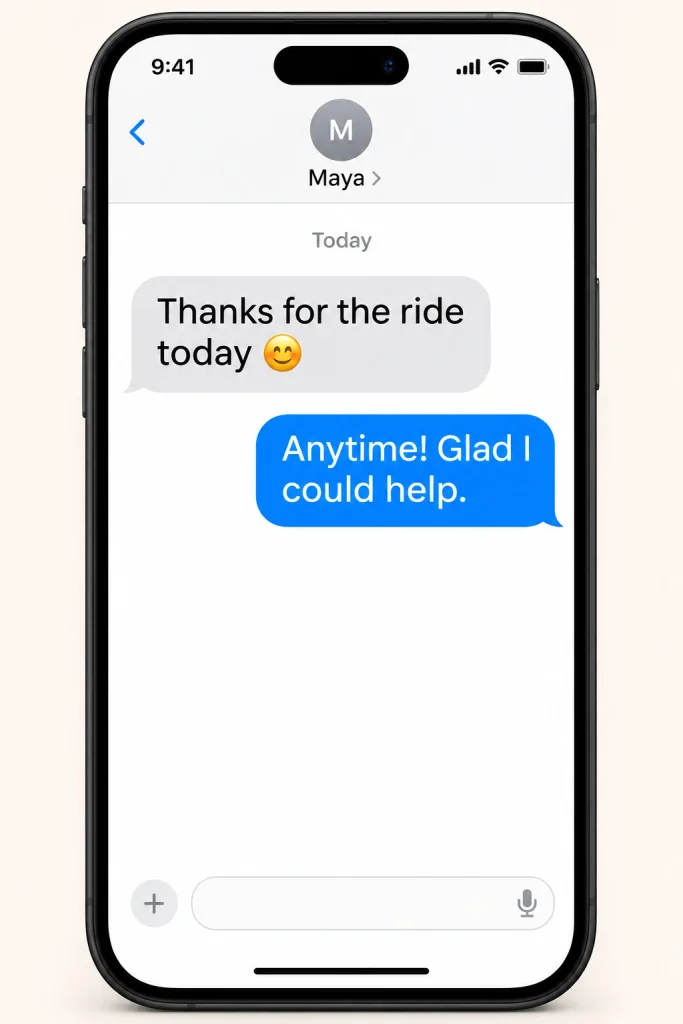
Maya’s smile supports the gratitude already in her sentence. Sam responds warmly through his words. His reply doesn’t need an emoji to match hers, and there’s no reason to treat that difference as a sign of distance.
😀 and 😄 bring more visible enthusiasm. “The tickets are booked 😄” feels suited to happy news or a plan someone is excited about. For a routine acknowledgment, that level of excitement may be more than you want.
You can also use a friendly smile emoji when replying to good news. “You got the apartment! That’s brilliant 😀” gives your friend something more personal than a reaction on its own. Add ✨ to emphasize the celebration, as in “Congratulations on your new place ✨.”
Support and Friendship
🤗 can suggest a virtual hug, a welcome, or affectionate encouragement. Its name, Smiling Face with Open Hands, describes the picture, while “hugging face” explains a familiar way people use it. For a more literal-looking hug, 🫂 depicts two people embracing and can convey comfort or support.
A friend might send, “Thinking of you. I’m around if you want to talk 🤗” after a difficult day. The offer to listen carries the support. The emoji adds warmth without making the recipient responsible for replying immediately. For affectionate appreciation, 🫶 shows hands forming a heart: “You really came through for me 🫶.”
Choose the level of affection that fits your relationship. A virtual hug may feel natural between close friends and surprisingly personal in a first conversation with a customer. You can be kind in either situation; the wording and familiarity guide the choice.
🤗 can also accompany a happy welcome. “You’re finally coming to visit 🤗” suggests excitement about seeing someone. Use the sentence to show whether you’re celebrating, offering comfort, or simply pleased to hear from them.
💛 is another option for affection between friends. “Thanks for always making time for me 💛” suits a message with some emotional weight. A yellow heart can also express love, appreciation, or someone’s personal preference for that color.
🤍 and 🩷 are other affectionate options. “Thinking of you 🤍” can offer support, while “That made my day 🩷” can express warmth. The color alone doesn’t establish a romantic or platonic relationship.
If you want a simple, low-key thank-you, 😊 may communicate your intention more directly. If you already exchange hearts with a friend, 💛 can fit comfortably. You don’t need to introduce a new meaning every time you use it.
Agreement and Cooperation
🤝 can accompany a cordial agreement or a shared task. Jordan might write, “Agreed. I’ll bring the projector, and you’ll book the room 🤝” after dividing up responsibilities with Priya.
👍 is another option for acknowledgment or approval: “Got it, I’ll send the file today 👍.” Pairing it with an answer helps the other person understand what you’re confirming.
Include the detail that matters. “Saturday at 10 works for me 🤝” gives the other person a useful answer. For a casual lunch with a friend, a plain “Sounds good 😊” may feel more natural. Pick the tone you actually use together.
Why Friendly Emojis Can Be Misunderstood
An emoji arrives without your speaking voice or facial expression. The reader has to connect it with the words, the earlier conversation, and what they know about you. That leaves room for a friendly intention to land differently.
😊 vs. 🙂: Why a Small Smile Can Feel Different
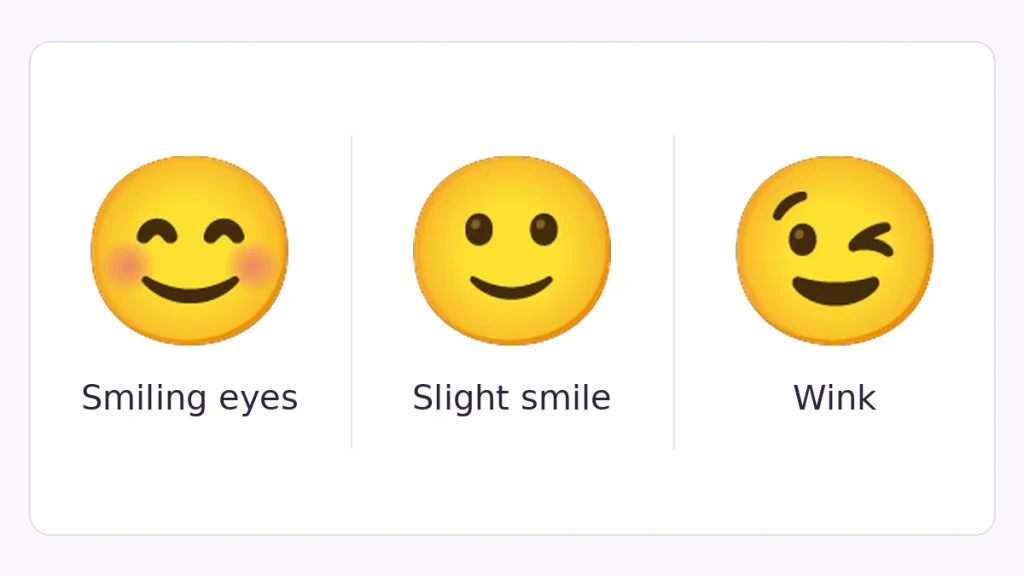
😊 has smiling eyes and a broad, closed smile, so it commonly suggests warmth or pleasure. 🙂 has a smaller smile and can feel more restrained. It can express sincere friendliness, but it also appears in ironic or passive-aggressive messages.
Compare the possible readings of the same sentence:
| Message | Possible tone |
|---|---|
| “Thanks for saving me a seat 😊” | Warm appreciation |
| “Thanks for saving me a seat 🙂” | A quieter or more restrained thank-you |
| “Thanks for saving me a seat 😉” | Playfulness, a shared joke, or possible flirtation |
These are illustrations, not fixed translations. If your friend sends 🙂 with every cheerful message, there may be nothing strained about it. If the conversation has been tense, even an ordinary smile can become harder to interpret.
Age alone won’t tell you which reading is correct. People within the same age group can have different texting habits, just as friends can disagree about whether a particular joke sounds dry or rude.
When you’re writing, add the detail that removes the guesswork. “Thanks for saving me a seat—I was worried I’d be standing all evening 😊” makes the appreciation clear. A more expressive face can help, but a specific sentence gives the reader more to work with.
Friendly or Flirty? Read the Whole Message
A warm emoji doesn’t establish romantic interest. 😊 and 💛 can appear in conversations between friends, relatives, colleagues, and partners. A wink can be a joke or a flirtation. The symbol alone doesn’t settle the question.
“It was nice seeing everyone today 😊” points toward a friendly group experience. “I’d like to take you out this weekend 😊” contains a more personal invitation. The difference comes from the words and situation.
Consider what happened before the message. Was someone thanking you for a favor, continuing an inside joke, or suggesting time together? Also consider whether this is how they normally communicate. A person who uses hearts with several friends may simply have an affectionate texting style.
Avoid treating a missing emoji as evidence, too. “I had a lovely time” can be warm on its own. Counting smiles, comparing heart colors, or reading a response delay alongside one character can take you further from what the person actually said.
Respond to the message you received. If a plan or relationship needs clarification, a straightforward question gives you a better answer than an elaborate interpretation of punctuation and emoji.
Friendly Emojis for Work Messages and Reminders
Friendly emojis can suit casual work conversations, particularly when the people involved already use them. The appropriate tone depends on the team, the relationship, and the subject of the message.
Casual Thanks and Team Messages
A brief 😊 can accompany appreciation: “Thanks for staying to help with the handoff 😊” tells a colleague what you value. 👋 can fit a welcome: “Welcome to the team, Priya 👋 I’ll send the meeting link shortly.”
Both messages remain useful if you remove the emoji. That’s a helpful check before sending: the person should still understand the appreciation, request, or next step.
For a friendly reminder, make the action and timing clear:
“Hi Alex, could you add the sales figures by 3 p.m.? Thanks 😊”
This gives Alex something concrete to respond to. “Friendly reminder 😊” leaves the task unstated. If there’s a reason for the deadline, add it: “I’m sending the report at four, so I’ll need the figures by three.”
One emoji is often enough for a short message. You can follow your team’s general style without copying every person’s habits. A colleague who writes plainly may still be perfectly approachable, and a formal client conversation may call for a straightforward sentence.
For first contact, start with a polite introduction and a clear purpose. You can adjust the level of informality as you learn how the other person communicates.
When Clear Words Work Better
A cheerful face can feel out of place beside criticism or disappointing news. “You missed the deadline again 😊” may come across as a pointed remark, even if the sender hoped the smile would soften it.
A more useful version is: “The deadline was Friday. Can you send an update by 11 a.m.?” It states the problem and asks for a specific next step. You can add context or an offer of help where appropriate.
Research on emoji use in workplace messages found that participants’ judgments depended on the emotional tone of both the emoji and the text. Those were simulated messages, so the findings don’t provide a rule for every workplace. They do support checking whether the expression fits what you’re saying.
For complaints, formal feedback, or sensitive information, concentrate on respectful wording. A clear explanation, acknowledgment of someone’s concern, and useful next step give the recipient more than a smile added to an otherwise abrupt message.
Does “Friendly Emoji” Mean Something Different on Snapchat?
On Snapchat, an emoji beside a contact’s name can be a Friend Emoji status indicator. That is different from choosing an emoji to make a chat message sound friendly.
According to Snapchat’s Friend Emoji guide, 😊 means the person is one of your Best Friends, but not your #1 Best Friend. 💛 means you are each other’s #1 Best Friend: you send the most Snaps to them, and they send the most to you.
Those labels reflect activity on the app. They don’t establish whether a relationship is romantic, and they aren’t instructions for interpreting a heart someone types into a conversation. Check whether you’re looking at a status beside a name or an emoji within the message.
For your next message, choose the words first. “Could you look at my draft when you have a moment? 😊” gives someone a clear request with a little warmth. “Thanks for the ride today 😊” gives a friend a clear thank-you. Pick a symbol from the table that fits the exchange, then let the sentence do its job.
Frequently Asked Questions
Is there one official friendly emoji?
“Friendly emoji” is an informal description rather than the name of one character in the Unicode list. 😊, 👋, 🤗 and other symbols can express friendliness in different ways. Choose according to whether you want to greet someone, thank them, offer support, or show affection.
Is a yellow heart only for friendship?
💛 can express friendship, but it can also show love, appreciation, or a fondness for yellow. It doesn’t have a universal relationship label in ordinary messages. Snapchat’s yellow-heart status has a specific app meaning, which is separate from someone choosing to type 💛.
Can I use a text smiley such as 🙂 instead?
Yes. 🙂 is a text emoticon, while 😊 is an emoji character. Unicode’s explanation of emoticons and emoji describes the distinction. A text smiley can add a friendly touch when it suits your usual writing style. Some apps may turn typed smileys into graphics automatically.
Why does an emoji look different after I paste it?
Different apps, devices, and fonts can draw the same emoji differently. Unicode’s design guidance allows variation in appearance. If you copied the actual emoji character, a change in its drawing doesn’t necessarily mean the copy failed. It may simply be the receiving app’s design. A box can indicate missing emoji support in the app or font; it doesn’t by itself establish that copying failed.



Pingback: Heart Emoji Outline Copy and Paste Symbols